Sunday, 22 January 2012

Across the Lai

Inspired by Charles Dickens' "The Streets - Morning" from Sketches by Boz.

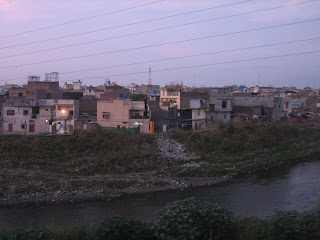


The surroundings resonate with the beautiful rendition of the Islamic call to prayer for the first prayer of the day. The single voice calling "Allahu Akbar" (Allah is Great) is soon joined by a multitude of other voices, some old and some young, until the words are barely discernible. In the semi-darkness of pre-dawn, the Nala Lai looks like a smaller version of River Thames (as my brother likes to put it), reflecting tiny lights from the surrounding houses which seem to be poised precariously close to the edge despite several warnings after floods in the past to move them back. As the sky begins to lighten very gradually in the cold December morning, dark shapes, which a wild imagination turns into beings from another land, start presenting their true forms as mundane unimaginative products of modern technology.

As I start taking photos of the sunrise, the bright orange on the horizon that stays its beautiful self in every part of the world, I'm struck, as always, by the contrast in my surroundings. As I look down from the front side of my house, other than the guard heating himself infront of the flames of his personal little bonfire and an occasional wandering stray cat or dog, the well-kept neighbourhood of retired army officers is engulfed in slumber and serenity. This side of my house hardly ever held my attention for long. The backside of my house, however, where the Nala Lai stretches out in all its filthy granduer (the piles of garbage accumulated along its banks are now visible in the morning light), the world across it has always interested me.


The stark contrast that both sides of the Lai present is fascinating if not sobering. The garbage that decorates the bank of the "other" side gradually transforms into a confusion of houses of various sizes, which seem to be interconnected - no sign of any open space let alone a garden. Some housing poor families moved here from nearby cities earning their livelihoods by working at the well-to-do houses across the Nala. It is, however, also the perfect hideout for our friendly neighbourhood thieves. Won't we know it, having been victims to one such gang!


As I take pictures of the cement bridge that stretches over one end of the Lai, an occasional car or two drives across. The bridge always reminds me of the bomb blast which was attempted to kill our former President Musharraf, who would frequent the famous bridge while going back and forth from the Army House in the heart of Rawalpindi. As I move my camera lens back to the houses across, I see a tiny speck with a large sack rummaging in the junk - a scavenger in search of recyclable material, most likely. (Unfortunately, the photo was too blurred to be shared.) I now hear cars starting up, as people start leaving for schools, colleges and workplaces.

As I pack up my camera and head downstairs upon completing my mission of capturing pictures of the sunrise, I continue to think about the two contrasting worlds on both sides of the Nala - sadly symbolic of the large economic divide between the rich and the poor in my country.


Tuesday, 17 January 2012

Re-learning Islam

... Bismillah ir-Rahman ir-Raheem (In the name of Allah, the Most Gracious, the Most Merciful). When he read the words ar-Rehman ar-Raheem, he was alarmed and threw the page down, then he regained control of himself, picked it up again, and saw the words:

"Ta-Ha. We have not sent down the Qur'an unto you (O' Muhammad) to cause you distress, but only as a Reminder to those who fear (Allah). A Revelation from Him (Allah) who has created the earth and high heavens." (Qur'an 20: 1-4)

As born Muslims we tend to take our faith for granted. Just because we had the privilege of being born to Muslim families, we think we automatically received a ticket to Heaven, hence, no more effort is required from our side. Therefore, gradually, religion becomes confined to the mosque and the Holy Qur'an becomes a symbol of reverence only to be kept on the top shelf. We grow out of the curiosity regarding life that we had as children. We become more concerned about which way the hijab needs to be worn or how long the beard needs to be instead of looking at the state of our hearts and determining whether we have conviction in our belief and love for Allah (The Exalted) and His Messenger (Peace and Blessings of Allah be upon him). (Not saying that the matters mentioned formerly are to be ignored, just drawing a comparison as regards to priorities.) Isn't that why, when talking to non-Muslims regarding Islam, we become defensive instead of making an influence? Because we inherited Islam instead of choosing it as a way of life, we often overlook the all-important step of understanding the basic concept of Tauheed (Oneness of Allah) - of truly connecting with the Creator with our hearts.

I only recently realised how much this conviction was lacking in my own heart. I had seen many videos and read several articles of Muslim converts who are prominent speakers on Islam today and they always had an impact on me. Yet, it is true when people say, nothing can compare to the real thing! I've lately been going through an extensive process of soul-searching, having resigned from my job and being unemployed for a good five or so months gave me ample time to reflect on what I'm doing with my life. It was as if Allah answered my silent prayers when I heard that Brothers Hamza Andreas Tzortzis and Adnan Rashid were visiting Pakistan as part of the Winds of Change tour and deep down I knew I HAD to go!

I was prepared to be deeply inspired but the profound effect that Hamza Tzortzis' and Adnan Rashid's talks had on me on the first day of the SIST 2012, held in Islamabad, still took me by surprise. It was as if, one by one, all the questions that had been tormenting me of late were being answered. How can I contribute to bring about a change in Pakistan? Why is Pakistan perpetually plagued by one trial after another? There has to be more to my life than what I'm currently doing. Attending the Da'wah Workshop, conducted by Br. Hamza Tzortzis a day after the event, seemed to further strengthen the process of change and realisation that had already begun. Giving a little background, Hamza Andreas Tzortzis is a Greek Muslim convert "who looks Pakistani" and is a senior researcher and lecturer for iERA, UK. He has engaged in several debates with prominent academics and intellectuals.

During the Da'wah Workshop, I realised why I always reached a point of frustration when attempting to answer questions regarding Islam that were constantly bombarded my way, mainly because I wear hijab. I realised that I don't need to be defensive about my faith, I only need to make people understand the beauty of the heart connecting with its Creator and recognising Him. It's as simple as that! Everything else follows naturally, belief in the Last Messenger of Allah, Prophet Muhammad (PBUH) and all that was revealed to him, obedience to Allah, belief in the Hereafter, etc. All it takes is firm conviction in our hearts - belief, love, trust and also fear of the Creator. If we lack that, then there is no way that we can convince anyone else!

As I was mentally assessing and soaking in all that I came across and learnt during the Winds of Change tour, I started reading a fantastic book on the life of Umar ibn Al-Khattab (May Allah be pleased with him) by Dr. Ali Muhammad as-Sallabi, given to me by my grandfather some time back. Had I read it at some other time, it might not have affected me as it does now. Especially the passages regarding Umar’s conversion to Islam, the verses that brought about the change in him and the basic concepts of Islam that Umar learnt with the help of Prophet Muhammad (PBUH) had a profound effect on me. I find the strength of Umar’s belief, his open display of faith at a time when it was dangerous to do so, his eagerness to learn at the hands of the Prophet (PBUH) and his insights on many verses of the Qur’an immensely inspiring!

These are the people who know what it feels like to be on the other side. To question, reflect, and then finally accept, instead of having Islam served to them in a plate. It is about time we, the born Muslims, re-learn Islam from them and renew our faith in order to effectively give the message to others as well. We cannot convince others unless we convince ourselves first. I will end my thoughts with Brother Hamza Tzortzis’ words that caused a stir in the audience at the SIST 2012;


“Don’t be like the feather blown about by the wind. We are the wind – the Winds of Change!”


Saturday, 8 October 2011

Behind every successful event is an unlikely team!

Watching the Kaghan Valley illuminated by the most beautiful full-moon at 3 am, huddled in front of a little stove in a tent while a hailstorm tries to rip it apart, singing along to ridiculous songs while sitting in each others' laps in open jeeps riding the bumpiest roads... 


These are just a few moments from one of the most exciting, exhilarating and inspiring weeks I've ever had while organising the TCKP Tour of The Himalayas 2011 International Mountain Bike Race and Mountain Bike Tour with The Kaghan Memorial Trust (KMT) in aid of its Kaghan Memorial School (KMS) between 14 and 20 September, 2011.  When I got back and saw all the media coverage which the event attracted, mainly due to the fact that in times when even Pakistanis living abroad think twice before coming here, we had around 30 International male and female mountain bikers coming all the way to Pakistan to compete in an event for no personal gain and to benefit children from an area which they had never visited before, I realised there is still so much more to the event that external media reports cannot cover. We all know that events don't get organised overnight and usually there is a group of people toiling away in the background to make things happen, what I found particularly interesting in this case was the combination of people that comprised the Orgnanising Committee of this particular event. 

I have had the privilege of working with KMT for well over 4 years now which has given me the opportunity to spend a great deal of time with people from varying backgrounds and cultures, belonging to countries ranging from the US, UK, Canada, New Zealand, Autsralia, Bosnia, Turkey and Sweden. Other than giving me endless opportunities to act as interpreter (even though my own Urdu is hardly above standard!) and tell a wide array of people about my culture, especially from a woman's perspective, it gave me the opportunity to learn about their diverse cultures. But above all these things it drove home the fact that humanity has no race, language or creed. After a long day when we would sit together to unwind, we were all just a bunch of women going through similar problems identifying with each other's emotions. Moments like those have made my time working with these amazing women truly memorable.

The race itself, which attracted a large number of foreigners to our benighted nation, not only reinforced this concept of humanity, but also makes one realise how false reports of intolerance regarding our country are. True, we are divided into endless groups and target each other in hatred, yet when it comes to guests from abroad, even people belonging to the most backward or least exposed areas were nothing but friendly and hospitable. Watching the rapport that developed between my people and "the foreigners" over the week touched my heart. Furthermore, when we were all caught unprepared with spare warm clothing in the middle of a hailstorm atop Paya, every one rushed to give their coats to the riders to keep them warm after the race. I can't help but think, why are we otherwise so preoccupied by differences and hatred when at the end of the day it does not matter? If an unlikely team of people from differing backgrounds and cultures can come together to make one event successful, why can't we come together more often at a much larger scale and solve much bigger problems that affect us all?

Moving on from my rambling, it was also touching to see the children of the School that this event aimed to benefit so excited by the race and it's participants. They learnt about the countries that the cyclists came from and they were also the spectators on the third day of the race, counting down with the Managing Trustee as he signalled the start of the race. The people who work with the organisation and are helping us in making this project possible also happen to be foreign volunteers who have come all the way to Pakistan to support a cause which is of no personal benefit to them or their countries. Things like these make one regain some of one's faith and hope in mankind. If only our own people were also more willing to practically participate in projects that bring about social change instead of spending most of their time being cynical, things could probably turn out much better for Pakistan.

How can I overlook the overwhelming beauty of our surroundings?! Words cannot accurately describe the breathtaking beauty of the Kaghan Valley and it's changing moods. The wonderful feeling of closeness to Allah (SWT) through the beauty of His creation. Funny how we rush to travel abroad for our vacations yet many of us have yet not explored the varying beautiful landscapes of our country!

Lake Saif ul Maluk
All in all, I could never write enough on the marvellous experience I had helping organise the TCKP Tour of The Himalayas! It was a truly exhilarating experience that will live in my memories for a very long time. Not to forget, the wonderful people I had the opportunity to meet and get to know! :-)

The Kaghan Memorial Trust is a non-profit charitable Trust registered in Islamabad in the aftermath of the earthquake that struck Northern Pakistan in October 2005. One of the Trust's immediate objectives is to establish the Kaghan Memorial School which provides free high quality education, health care, meals and clothing to the earthquake affected children of the Kaghan Valley. KMT organises various fundraising events as part of its Income Generation Programme to support the School, one of which is the Tour of The Himalayas. More details on the Trust can be found on their website: www.kmt.org.pk. 

Saturday, 10 September 2011

A Letter to my Diary

Dear Diary,

How long it has been since I last shared my thoughts with you! Even though this is precisely how I would start every single entry, this time it has been long, indeed. Why have I thus abandoned you and moved on to other mediums of expression, oh confidante of my childhood? Just because my writings were limited to your pages alone (or the occasional nosy parker who would peep through!) does that mean I abandon my old loyal friend and move on to other fickle companions?

Things have changed a great deal since I befriended you in the 90's. The advent of the internet has changed the way we express ourselves. As we have discovered a medium that makes our writings available to the world, who would need to keep a diary and undergo the tedious process of picking up a pen and writing hoping that some day a curious passer-by will read it, publish our work and make us famous? Other than the occasional teenager who uses your time-worn pages to lament unrequited love or doodle in idle time, gone are the days when great writers and thinkers recorded journeys and events in diaries. Who needs to labour with the art of beautiful handwriting when you can write perfectly legibly using a keyboard? 

As handwriting turns into a scrawl, and words lose their essence, blogging, tweeting and commenting is increasing in momentum. Yet can our Blackberries, iPhones, iPads and laptops replace the personalised experience that writing with pen on crisp paper brings? Nothing can make up for the beauty of words gradually taking shape as the pen caresses the page etching our words to be preserved in time to be opened many years later and the experience relived. As I flip through your pages, I can still smell the scent preserved in your folds with loving care, visions jump up at me of childhood memories preserved in writing and lessons learnt are re-learnt.

Alas! Times change and so should we. Who knows when I need the privacy of your scented pages to record moments of silent frustration and soak your pages with tears of agony like I used to? After all, don't they say that a loyal friend stands the test of time? 

Your old fickle friend,

Mariam


Thursday, 11 August 2011

How will YOU celebrate this Independence Day?

As 14th of August (Pakistan's Independence Day) draws near, I see people from all walks of life in my country preparing for the "big day" in their own ways. Cars start appearing with the national flag perched on them, stalls selling flags, badges and everything green imaginable show up on road sides, profile pictures on the internet suddenly change to depict the flag or the Quaid, and of course, who can miss the rehearsels for bike stunts! It is definitely a day of great national pride for us and the feeling is shared by every Pakistani no matter which part of the world they live in. Yet amidst all this hype to celebrate can we at least stop and think what we're celebrating here?

Why is it that the moment someone starts to question anything in Pakistan, either their loyalty to this country or their faith starts getting questioned? Being Pakistani or independent is not just about flaunting the national flag and calling yourself "Pakistani and proud". We are all well aware of the circumstances that we are living in and they are definitely not getting any better with every passing day. Whatever few achievments we have had are mostly limited to the hard work of some individuals. There is hardly anything that we can be collectively proud of as a nation. Have we ever stopped to question ourselves why that is so? Is America or India or any other country really responsible for our troubles? Is it fair to pin everything on our government or the military when they actually came from amongst us? 

This is not an attempt to dampen our joy in celebrating this day, but a reminder to stop, think and question - something we have forgotten to do of late. Only by attaining self-acceptance will we truly be able to solve our problems and take out our beloved nation from the rut it is stuck in. What I also find baffling are visions of Pakistanis across the world who probably have never set foot in this country suddenly overcome by a wave of patriotism come August 14th or a Pakistan cricket match. True, Pakistanis abroad tend to feel more strongly about the country as they're away from home, but for once can we burst out of our idealistic bubbles and accept the reality we are living in? The residents of Pakistan may have their fair share of sarcastic humour and cynicism but it all stems from the circumstances we are living in and witnessing day in and day out. 

Coming back to the subject, how would putting up lights and singing national anthems on one day help this country? Is that all the Independence Day is about? Instead of flaunting our patriotism with words, why not prove it by putting the proverbial money where our mouths are? In order to celebrate the Independence Day in the true sense of the word, the least we can do is take the first step towards building a sustainable Pakistan so that the future generations would actually have something to celebrate. There are countless people struggling with very worthwhile projects based on education and sustainability. I say, let's celebrate this Independence Day by contributing our resources, monetary or otherwise, in helping these projects attain their goal towards a better Pakistan. It's the least we can do if we can't make any similar initiatives of our own. We need to especially inculcate the spirit of volunteerism in our youth which comprise such a major part of the population so that they bring their spare time to constructive use, instead of whiling it away in front of TV screens, video games or the internet. If we look at it this way, if every single educated Pakistani would take upon him/herself the responsibility to educate one disadvantaged child, imagine the difference that could make! 

So, how will you celebrate this Independence Day? 

The author is an Anti-Drug Ambassador for the Ministry of Narcotics Control. The Anti-Drug Ambassadors are a group of young people from diverse backgrounds dedicated to the cause of eradicating or reducing significantly the impact of illicit drug use amongst the youth of Pakistan.

Saturday, 6 August 2011

Viewer discretion advised

As I flipped through the channels while watching TV, I stopped at one which had a bold message across the screen.


As the show in question started, my mind drifted off to other terrains. All I need to do is switch to one of our news channels and, lo and behold! Images of violence and gore grace our screens day in and day out. Heck, you don’t even need to switch channels. If you’re living in Karachi, walk out on the street. No one will come to you with a sign that says, “Discretion advised, things are going to get messy here”, before a bout of target killing ensues at the whim of a group of lunatics who believe only a certain sect/class/race of people have the right to live. 

The impact of violence on our country can be seen by the fact that when you enter “violence” in the search bar on the internet, the fifth result on the Google page is “Major incidents of terrorist violence in Pakistan, 2011”. (Missed taking a screen-shot and even though the result page is different now, Pakistan still features on the top somewhere.) There was a time when hearing of a bomb blast used to make us exclaim in horror. Now, we’re surprised if we hear of only one. Why is Pakistan thus gripped by this never-ending cycle of terrorism and violence? If you were to ask us this question, you would get varying responses depending on which school of thought that person belongs to. The “liberals” will tell you it’s due to the “extremists”. The religious “fundamentalists” will say it’s an American conspiracy to destabilize Pakistan (meaning we were actually stable at some point?). Your random Taxi driver will say it’s a Jewish conspiracy or India is behind it. You will hardly hear anyone say, “The problem lies within us. Intolerance, suspicion and hatred has been so deeply ingrained within us over the years that its inevitable outcome is the violence that has now gripped the entire country”. Why you won’t hear anyone saying that is because “self-acceptance” is a trait we lack amongst others. 

Pakistan, however, is not just all negative adjectives. If there’s any good that I see in my country, it’s potential – lots of it. In the form of our youth that constitutes a staggering 63% of the entire population. If you were to ask me the solution to the many problems in our country, I would say channelize this colossal potential in the right direction, and the best way of doing that is by education. The “education” I’m referring to is not a catch-phrase that is thrown about by NGOs or a statistic to show that we are meeting the Millennium Development Goals. It is very aptly put by John Dewey as, 


“Education is a social process; education is growth; education is not a preparation for life but is life itself.” 


If we were to consider it as Dewey puts it, our education system needs some serious revision.
  1. Knowledge imparted needs to be accompanied by examples of practice in the real world. Knowledge is incomplete without implementation. Our national education system mostly relies on the rote system and our students leave school without any clue as to how they should apply what they learnt in their lives. 
  2. As a nation we are physically extremely inactive. Some members of the elite class have started frequenting gyms on a regular basis but our middle class hardly engages in any form of physical exercise in their daily routine. Schools also don’t give importance to sports as part of the curriculum any more. Exercise and sports are a great way of venting the negative energy within us, necessary in the times we’re living in. 
  3. Religious education needs to focus more on the individual’s character building. Along with teaching the Arabic text, effort needs to be made to understand the content of the Quran and its implementation in our daily lives. Islam, in essence, is an extremely tolerant religion and the text should not be misused to make our youth think otherwise. 
  4. Wisdom passed down over centuries in the form of storytelling should not be replaced by a completely Westernized approach to education. We need to stay true to our values to retain our identity. 
  5. Give the true version of history. Everyone has the right to know.
All in all, we need to focus on nurturing well-rounded individuals and we need to also understand that this process will take time. No one, especially not the government, can wave a magic wand and change this nation for the better overnight, because unfortunately, in real life you can’t change the channel to what you want.

Sunday, 31 July 2011

Rehabilitation: Whose responsibility?

As we walked into the room, eight pairs of eyes turned to us. Sunk in sallow faces some had a flicker of hope in them while some seemed lost. Their owners sat on their respective beds, neatly arranged to fill the narrow room. There was hardly any space to stand in the white-walled, hospital-ward-looking room where the smell of human sweat permeated above all else. Yet, for some reason, all these things didn't matter because the look in their eyes spoke not only a mixture of deprivation, silent war and hope but also expressed gratitude every time they looked at our guide.


I, accompanied by twelve other Anti-Drug Ambassadors for the Ministry of Narcotics Control, visited the Model Addiction Rehabilitation and Treatment Center (MARTC), Islamabad yesterday. Other than being informative, the visit also left a deep impression on my mind. For some reason, it reminded me of the time when I went to the General Hospital in Rawalpindi to help the 2005 earthquake-affected victims that had been brought there from the Northern parts of the country. The same stifling heat, sense of loss and depressing atmosphere. The difference was that those people were there due to a natural calamity, yet these people were here due to a self-inflicted disease – that of drug addiction. Whether it was forced on them by peer pressure, or they were drawn to it to make up for whatever was missing in their lives, what upset me was that these people didn’t need to be there. It’s all a matter of saying “No!” when you still have the chance. 


While walking through the scantily furnished rooms of the Center, we criticized the oppressive environment and the impact it might be having on the inhabitants. However, every room we walked into, some of the patients readily greeted us by either smiling and, in the case of one teenager who was suffering with schizophrenia as a result of hashish addiction, rushed forward to shake hands with us. One could not help but be touched by the gratitude that the inhabitants made a point of showing to the doctors and staff that were aiding them in their path to recovery. It is so easy for us to criticize our establishment for all the problems in society, yet when they make an initiative, how many of us draw forward to help? As I looked at the bare walls of the rooms, I could think of so many ways in which young people, volunteers or interns can contribute in brightening up the place and make it homely for the inhabitants. The suggestions we made were appreciated but where are the people to do it? The centre we visited was catering to roughly 35-40 drug addicts, a small number, yet the fact that even this small number was getting this support in recovering from a disease which could have even been fatal for them goes a long way in helping these people. I tried to absorb all the information that we were being given on the various stages of rehabilitation and treatment and at the same time my head spun, searching for ways to help, trying to understand the circumstances that lead those people to where they were. 


Those responsible for the spiritual grooming of our people, our religious scholars and maulvis, are so busy figuring out where Jihad is valid and where not, that they so easily overlook the more preferred Jihad bin Nafs (War with self) which forms the essence of one’s spirituality. People tend to be drawn towards crutches like cigarettes, alcohol, and most of all illicit drugs to make up for something that is lacking within. That something which society and its mentors play a great part in making up for. Though most of the patients at the MARTC admitted that they were drawn to illicit drugs due to peer pressure, isn’t it mainly due to a weakness within ourselves that we are so easily lead into doing something that we know to be so destructive to our lives? This doesn’t only mean that there is something lacking on the part of the individual but also reflects on the condition of our society. Like someone very aptly said, “No drug, not even alcohol causes the fundamental ills of society. If we’re looking for the source of our troubles, we shouldn’t test people for drugs, we should test them for stupidity, ignorance, greed and love of power.” These were the thoughts that crossed my mind as I looked at the patients at the Center fighting everyday against an addiction that could’ve so easily been prevented. That can still be prevented if we work together to nurture a society that is not only aware, but also supports and understands each others’ needs.  

The author is an Anti-Drug Ambassador for the Ministry of Narcotics Control. The Anti-Drug Ambassadors are a group of young people from diverse backgrounds dedicated to the cause of eradicating or reducing significantly the impact of illicit drug use amongst the youth of Pakistan.